Why Water Operators Still Run Blind — And How Real-Time Microbial Monitoring Changes That
This article is a transcript extract from the Don’t Waste Water interview with Orb Founder & CEO Lorenzo Falzarano, discussing real-time microbial monitoring and operational blind spots.
Watch to the full episode here: https://www.youtube.com/watch?v=0Dy9HG8aKwU
Antoine: Hi, Lorenzo. Welcome to the show. It’s a long overdue one, I’d say, but let’s start with a bang. On your website, you say you’re 1,700 times faster than the incumbent methodology to count microbial pollution. What does a 3‑second sensor do that others don’t and why does it matter?
Lorenzo: Let’s break that down. The 3 seconds or 1 second, I mean, we can take thousands of scans in a second. We’re at the speed of light. The maximum scan rate or fastest is 1 minute resolution because any more data than that is hard to process. But we can do 10,000 scans in 10 seconds if needed.
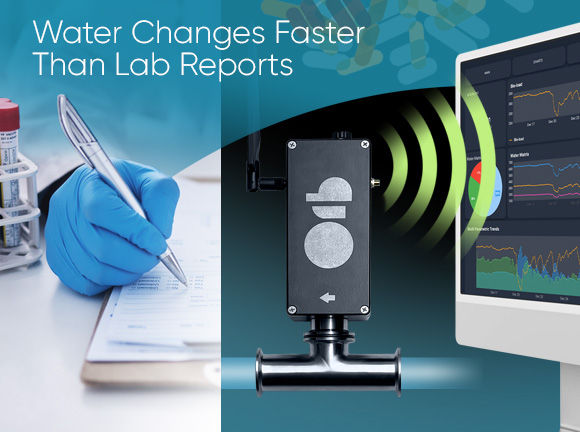
The problem with the current incumbent solution is that we’re using a technology that was invented when we were still riding horses as our main form of transport, where today we have the self‑driving car. But the technology we’re using for microbial detection is a 3‑day lab test. You grow, you incubate the bacteria, you’re getting less than 1% resolution of the total microbes present.
And so that 3‑day delay between the water you’ve sampled and when you get the results means that the world has to run on what’s called the worst case scenario principle or the precautionary principle. Add maximum chemicals or maximum heat or maximum production downtime. Everything’s maximum because you’re running blind. And so that’s the basic premise that the global operating system behind water and infrastructure runs.
Water feeds into every part of our economy and society, from drinking to process to data center cooling to flushing your pipes and cleaning them to medicines to ingredient water in your product. They’re all running on this 3‑day lag. That means we have baked‑in inefficiencies.
So what a 1‑second detection gives you over three days is the ability to preemptively identify and address a risk event before it becomes a regulatory compliance failure or a public safety issue or a facility shutdown, depending on the application.
Antoine: If we’re specific, the 3 days is because you take a sample, you put it in a petri dish, you let it grow, and then you count it by sight. So you need it to grow sufficiently so that you can see it, which makes me believe that you’re measuring something else. I’m not trying to oppose different approaches. I see that as an absolute perk to see different approaches. If I understand it right, you’re measuring the proteins and there are other incumbents in that space which measure the enzymatic activity. Is that different from what you do? And what’s the trade‑off there?
Lorenzo: Amino acid level, which is a building block of a protein, as well as a protein, as well as a protein that’s inside a cell.
When you have microbial cells, they’re going to fluoresce and give off more light than just free‑floating aromatics will have. So we’ll be counting the total. Once you’ve got rid of all those microbial cells, maybe post‑RO if your RO is functioning correctly, then you’re left with the viruses, which we can also detect because they’re building blocks of proteins. So we’re really, really super sensitive.
The difference between the enzymatic processes and us is these are requiring reagents and time as well to run their processes. We are a non‑invasive, non‑destructive method. We’re using the power of light, of photons, to probe and deliver that information to us.
The enzymatic processes are adding reagents to those processes. It’s a more complex system.
Antoine: I think we now touch on some of the specifics of what you do. I’d like to have your elevator pitch. If you have the 40‑second version.
Lorenzo: We give operators that monitoring, and we do that with our inline sensors that pick up microbial signals continuously without the need for any reagents. So it’s a non‑destructive, non‑invasive method. And then our intelligence platform turns that into insights, not only delivering trends but also finding the most likely root cause for an event if that event happens.
It’s one thing to get “my bacteria levels have gone up,” but the other is “why?” And that’s what we help our clients do with our intelligence platform. So it’s the combination of the sensors plus the intelligence platform.
Antoine: I’m going to take the intelligence platform and put it in the fridge, because I’m super interested in looking into that. You have a stat on your website which says 70% of the cases are cold cases in water, something happened and you have no clue what happened. I’m guessing your intelligence platform solves that. But let’s use that as a teaser for what’s coming.
Before that, I’d like to go back to your track and your path because Orb is your third venture if I count it right. You have Better Energy Systems, now called Solio. How does that build your path? How does the story end and how do you end up doing something else?
Lorenzo: I’ll take a step back just before the genesis. In my 20s I was obsessed with resiliency. My first career was a derivatives trader in the financial markets and then I decided to jump ship and go back to basics. I wanted to add value.
Then I was on a two‑year overland expedition around the Amazon and Orinoco basin working with indigenous tribes, learning about how they live, looking at eco‑village design, sustainable and appropriate technologies. We were installing Pelton wheels, passive designs and architecture. For the first six months or year, I had a very intimate relationship with water. We bathed in the Amazon, drank from the Amazon or the Orinoco, had a little ozone treatment system and iodine drops, and we saw how others lived with water.
Then I thought there are so many people doing good work at the grassroots level. I thought I’m going to go back, do a master’s, and then everyone will listen to me. One of my many false assumptions. I was going to go to the UN. That was the idea.
My master’s thesis asked: with the current social‑political environment, can global environmental agreements be implemented in time to avert dramatic climatic changes? I had to go into game theory, international relations, finance. I realized the UN wasn’t going to be the place to create change.
That’s when I realized change would have to come through technology and brands. So I had to build technology to inspire markets to drive them to more efficient sustainable practices. At that time, solar was the new darling. This was 2000–2001.
I met my co‑founder while organizing a jam session above my sister’s pub in Camden Town in London. We saw a gap between the world going mobile and battery power not keeping up. So we took solar panels off rooftops and put them into a trifold design that fit in your pocket and gave enough power to charge a phone or small LED light.
We got traction in the US, moved the company there, sold through Apple stores worldwide, Vodafone, FNAC, and more. We sold over a million units and then started selling into electrifying villages, micro‑grids, helping eliminate kerosene lamp fumes, improving light quality for studying and reading.
It’s about resiliency in primary drivers for society and for humans to exist.
Antoine: But I’m missing a step in between. You sell over a million units distributed in Apple stores, FNAC, Vodafone. How does the story end? How do you end up doing something else?
Lorenzo: There were corporate governance issues, disagreements between myself and my partner on management styles, and disagreements between the VCs we had at the time and our global expansion vision. They weren’t interested in the Africa side and some of the other projects we saw as part of an ecosystem and growth. So I left.
The co‑founder was replaced, the VCs brought someone else in, and from that point the company just closed and died. For me, we’d proven you could make an environmental technology sexy, respect the environment, and deliver a sustainable product. The rest was management and growing.
Antoine: There’s one in between which is Stealth Water. What’s the story of that?
Lorenzo: I was looking for the next big thing. I’d burnt out from the 10‑year process with Solio and thought I’d take a year off. A couple of years later I still wasn’t sure.
I wanted maximum impact: how do we drive markets to more efficient sustainable practices with minimal input? I realized true power lies with the citizen or consumer. Governments follow citizens’ votes and the economy follows consumer spending patterns.
I went through multiple mental pivots. I looked at vertical farming, then realized I’d be growing leafy greens for local restaurants. Not enough impact.
I realized we need resiliency in food, water, and energy infrastructure given unknown climate shifts. So I started looking at water technologies. Water is the other primary driver. Stealth was looking at passive design: using hydrogen bonding or capillary action. The idea: instead of taking contaminants out of the water, take the water out of the contaminants and treat it as it passes through a membrane.
I worked with a scientist, but they wanted to stay academic. I decided to lay that to rest and looked at other alternatives.
Antoine: You go from membranes to deep tech UV. That doesn’t make sense as a linear path. What takes you to that field and makes you finally embark on that one and stay on for a decade?
Lorenzo: Stay with me. I pivoted back to vertical farming in a different way: bring technology to farmers to help them use resources more efficiently and adapt to soil that’s already there.
I looked at soil sensing. I spoke to leading soil scientists with the biggest soil library. They used a mid‑IR spectrometer. I went through my network to understand why it costs 25,000. I learned about cooling, heat, and component costs. We could build it at a price point.
But then I thought about pedagogy and education. I worked on a school and rainwater catchment system in Ethiopia. Ethiopia has 88 languages. Not everyone reads. Communicating via an app across multiple contexts was a nightmare. So I let that go.
But I stayed with the sensor idea. I then asked what I care about most. We were seeing reports about endocrine disruptors, fertility rates dropping, plastics in water. People said: we didn’t know or we can’t detect it. So I asked: why can’t we detect it?
I wanted to democratize access to empirical data: a technology in the citizen’s hand to scan fruits, surfaces, water, and know what’s in it. That was the idea.
So I hunted for a non‑invasive, non‑destructive method, eliminating inefficiencies and cost of lab processes.
Antoine: Devil’s advocate. If people didn’t want to know, they’d rather bury your technology. Do you get my point?
Lorenzo: My initial assumption was to leverage the consumer and citizen. The consumer wants to know. Look at the growth in organic food and bottled water. People don’t trust tap water or what’s on produce. This was a way to let the consumer decide and let industry react.
Antoine: That sounds like 120Water. They started with transparency to citizens and pivoted B2B. Is that roughly what happened with Orb?
Lorenzo: I wasn’t able to raise funds for the consumer market, but I went through the Imagine H2O accelerator. We got closer relationships with the industry, got in front of utilities, learned their problems. It’s full of people with good intentions. It’s hard to get a technology to solve it.
It was an opportunity pivot. A way to go directly with those delivering clean water, understand the system intimately. And that path can fund development.
I’m happy we did it this way because our tires have been kicked. We’ve been asked hard scientific questions. We’ve been judged and tested. We have independent third‑party validation. Anglian Water sent us to Cranfield University, and they independently validated the technology, and Suez as well. We’re focusing on microbiology. We can do endocrine disruptors and plasticizers, but for now we focus on microbiology because that can kill you within days whereas others can kill over time.
Antoine: How do you build the tech? I get how you call people and get insight, but you still have to do it.
Lorenzo: This is how I did it. First you need a chunk of innocence and naivety. I don’t have a PhD in optics or microbiology. So I had to find people I trust. My algorithm: people at the end of their career who recently retired, top of their field, looking for pet projects, with decades of knowledge.
I reached out to Lonnie Lane, 45 years at NASA, principal engineer for Voyager 1 and 2 and Mars rover detection systems. He’d looked at non‑invasive, non‑destructive ways to look for life on other planets. I wanted to apply it to Earth systems.
We met, he liked the idea, took me under his wing. We got deep into optics: detectors, optical angles to maximize fluorescence, and whether we could do it with off‑the‑shelf detectors to hit the price point.
He helped me hire my first chief scientist. That trust let me build the team, and it snowballed.
We validated the optics and alignment in a small package. Then we built a spectral profile of bacteria and chemicals.
Antoine: Is that linked to your NASA grant?
Lorenzo: Unrelated. The NASA grant came later from an open call for real‑time monitoring for long‑duration space flight and space station missions for monitoring bacteria in water. The ISS has a 98% closed‑loop water system. They needed detection of about 13 strains of bacteria, yeast, molds common on the station.
Antoine: On fingerprinting: with spectroscopy you need a “picture” of every usual suspect. How do you pick what to fingerprint?
Lorenzo: At that stage we focused on microbiology. Internally we had a whiteboard session listing things we could detect: industrial chemicals, microbiology, pharmaceuticals, detecting in biofluids, on surfaces, on fruits and vegetables, and in water. We built a funnel to down‑select. Three years later we were still on that funnel due to complexity.
We decided not to do chemicals because chemicals can metabolize in the environment and their structure changes, so the spectral profile changes. Microbes stay the same.
We built a spectral profile with millions of data points on big organisms: E. coli, Salmonella, Staphylococcus, Legionella, Pseudomonas, Bacillus. We looked at signatures when growing, dying, dead. What is dead? What does happy look like?
We built it into our library, applied deep neural nets on millions and millions of data points to determine the minimum wavelength channels on excitation and emission sides to give specificity between strains. We tested mixtures: E. coli in river water, E. coli mixed with Salmonella, mixtures in orange juice, river water, etc. The neural nets identified needed wavelengths.
Then we built hardware based on that model and validated it again. That took around three years.
Antoine: Wavelength selection is for cost. Minimum viable number of wavelengths to be accurate while not killing the bank.
Lorenzo: Exactly. Otherwise you’re a broad spectrometer, a lab‑based system. We took a lab spectrometer the size of a small fridge and hyper‑focused it for microbiology.
In doing that, we became 400 times more sensitive than a lab‑based spectrometer because we use photon‑counting detectors, counting individual photons coming back, whereas lab spectrometers use gratings and are less efficient because they are broad. Once we knew the target, we optimized hardware for that target.
We optimized for drinking water: water that’s been treated and assumed safe.
We can do rivers and raw water, but stakes and market differ.
Antoine: Operational challenges like fouling, clogging, maintenance, calibration. How do you overcome that?
Lorenzo: We don’t maintain it. We intentionally did not develop a brush system to clean the window. That’s more for raw waters with biofouling, and may be in future. But we wanted to be validated and certified for inline within drinking water pipes. Adding screws and moving pumps and valves adds regulatory hurdles. The beauty of clean water or drinking water is less fouling.
We’ve had units in the field for 2–3 years that haven’t needed any cleaning. Recently we had an issue with high iron content before iron flocculants. If you put an optical system where big iron filaments settle on the window, it attenuates the beam. We can’t design for every case.
In deep UV it’s not comfortable for microbes to exist, so we’re not seeing settling on sensor windows. We design angles so the water flow naturally cleans. The windows are angled to eliminate bubbles collecting and reduce fouling: passive design to limit biofouling.
Antoine: Regulation isn’t in favor of your solution either. Operators still need to take petri dish samples. Do you aim for freeing them from petri dishes eventually?
Lorenzo: We don’t need regulation to move, but we are working with regulators indirectly. Utility customers deliver our data to the Drinking Water Inspectorate to show how they investigate and safeguard public safety. Although we may have a failure on plate counts, other analytical methods may not show issues, or we help identify likely root cause.
In the UK they use the CRI (Compliance Risk Index): severity, assessment and response, volume, population served. If above a level they get fined. Our clients were hit with £16 million in fines for bacteriological failures alone, £10 million the year before, due to CRI. Orb helps show they are taking care of public safety and investigating.
It will be a 10‑year journey, maybe more, before regulators ask for online fluorescence as a standard like turbidity or chlorine monitors.
Antoine: Back to the “70% cold cases.” Your website says 70% of cases are cold cases. Do you bring that down to zero?
Lorenzo: I’d love to give you that data. We don’t have it yet because it needs to be longitudinal. It’s only been a couple of years on certain sites and probes get moved. If we were mass deployed across an enterprise network, we could catch events as they happen and bring those down.
Right now it’s often: “we have a problem, move the probes over there,” but the problem is already gone.
That 70% number came from a 10‑year study across all UK utilities where 70% find no root cause.
We have caught events customers take action on: ozone dosing failures, chlorine dosing failures, non‑return valves not working, and more. But we can’t prove a negative that it would have failed.
Long term reduction likely comes with full deployment across an entire network, watching CRI come down, building trust and scaling.
Antoine: So long‑term vision is instruments across the network, not only plant, with a grid mapping?
Lorenzo: The more sensors you have, the more data points, the more intelligent you become.
About 50% of standards failures happen at the water treatment works and about 50% at service reservoirs or storage tanks in distribution. The majority are coliform failures. The top five of the top 10 failures are bacteriological. It’s the number one reason. It’s the only thing we’re not monitoring in real time.
Orb is the missing link. Utilities monitor turbidity and chlorine. That does not give microbial insights. Often there’s no correlation between turbidity and microbial levels. We have to build trust.
Antoine: You mentioned “insight.” How do you go from measurement to insight? What do you deliver to the operator?
Lorenzo: High resolution data: temporal resolution (scan frequency), sensitivity, and spatial resolution. Deployed probes create fingerprints because we detect down to the molecular level. Anything that touches water creates a fingerprint: pumps, flow rate, backflushing, etc.
With fingerprint signatures, you map them. Water is non‑compressive, so what happens travels down the network. We match peaks and see relationships: where the event started, its history in the journey through the network.
We do math, signal processing, peak matching to help investigators find the most likely root cause. You can run analysis to see which processes correlate to risk and then focus there rather than a thousand variables.
Antoine: That still sounds expert‑level. I assumed AI translates it into a green‑yellow‑red view for an operator.
Lorenzo: Each sampling point has a unique heartbeat. First you deploy and understand baseline. Water is not flat. I’ve never seen flat water. Even after treatment there are signatures.
Clients can set alarm thresholds after establishing “what does normal look like.” They get an alarm on breach, can run a report or speak to us. They will know which assets most likely caused the event and can investigate: maintenance vs ingress vs other issues.
Antoine: What are you selling: a sensor, data, or insight?
Lorenzo: We’re a hardware‑enabled data company. We’re selling insights, peace of mind, quick resolution, protecting public safety, in an easy‑to‑use, easy‑to‑deploy fashion. We deliver insights to help you understand water at a level not previously available.
Antoine: Recurring fee or capex sale?
Lorenzo: Two models: capex/opex mix, or pure capex if you pay five years up front. We adapt to procurement needs.
Antoine: Utilities need tenders, and you’re in a lane of your own. How do you overcome that?
Lorenzo: That’s not our challenge. Clients look for online microbial monitoring systems. There are other techniques: enzymatic, flow cytometric, etc. We’re unique enough that they either want us or they don’t. If they want high resolution at a lower price, easy to deploy, no chemicals, they come to us.
Antoine: Where do you get the best traction, UK or US?
Lorenzo: We didn’t get traction in the US. More traction in the UK and Europe. Online biomonitoring wasn’t really a thing in the US; they treat differently, heavily chlorinate, use RO. We’re deployed in about four countries. We’re about to deploy in Italy. We’re in France, Belgium, UK, across industrial and municipal/utility.
Antoine: You’ve been through Imagine H2O and Xylem Innovation Labs, but you’re bootstrapping. Hardware needs cash. How do you see the next 12 months and the long future? Partnering with big guys, or big rounds?
Lorenzo: We need to do a round. Whether VC, strategic, or bank financing. We need an injection of cash and we are doing a round. We need to scale the team. Right now we are two full‑time in two offices, which is pressure. We bring engineers in as needed.
I’m the CTO. We have a Chief Scientist. I’ve brought on a VP of Engineering (can’t say who yet), with experience in sensor development in water. They’re advising now, will come on once funding is in.
Key is removing risk gates before burning cash with a big team.
Antoine: What key milestones over the next 12 months?
Lorenzo: Milestones are building up the team and getting funding in, getting current technology to TRL 9. TRL is technology readiness level 1–9. We’re at TRL 8. To get to 9 is fully certified: UL, CE, NSF, and other marks, plus manufacturing and supply chain solid. If we tweak hardware, recertification can be needed, so we stay at 8 while we iron out manufacturing.
The bit missing between 8 and 9 in water is often commercial references, but we are commercializing at TRL 8 with innovation‑journey clients. We’re transparent: if an issue happens, we replace it. Anglian Water has been with us since 2019. Same with Pidpa and others under NDA.
Certification and scaling the team. Also building backend infrastructure and preparing for AI. We’ve used machine learning and deep neural nets. Now we prepare infrastructure for LLMs and what AI will bring.
Antoine: LLMs. How does that connect to your vision?
Lorenzo: We started building an LLM last year and stopped because it’s progressing so fast it may be defunct. You can train LLMs as specialists: multi‑agents, each a different specialist. Then you interact with those specialists when you see something on the chart.
Where do you need language? When you want to interact with data and ask questions about your data and what you’re seeing. If you’re a data scientist, you don’t need it. If you’re an operator, you may not be one. The LLM simplifies and streamlines so you have accurate insights. Different clients will interact at different levels: microbiologists, process engineers, chemists.
My design remit for startups: easy to use as pushing a button, easy to read as a traffic light. We invest embodied energy up front in design so it’s seamless for clients. Plug‑and‑play.
We’re inbound only and select high‑value customers.
Antoine: Rapid fire questions. What is the toughest challenge for a water tech startup?
Lorenzo: The water industry. Sales cycle. False assumptions. All good.
Antoine: Best single advice for founders and managers of early stage water startups?
Lorenzo: Validate or crush your assumptions as quickly as possible. Most will be false. It can cost you a year if you sit by yourself thinking something is good. Have a hypothesis. Test your hypothesis. Also: make sure your champion can make decisions. Sometimes the champion has no recourse outside their small area.
Antoine: Drop of knowledge you wish more investors knew about water sector?
Lorenzo: Water is one of the main drivers in our global operating system. It’s not free and it’s at risk. For water investors specifically: we are the missing link in water risk management. Turbidity and chlorine monitoring is ubiquitous and a non‑health risk marker. With faster treatment cycles, reuse and recycling are the future. You need to validate water instantly. You’re not going to store millions of gallons waiting for 3‑day test results. Real‑time monitoring is the future.
Antoine: Most unexpected partnership and what did it bring you?
Lorenzo: Lonnie, the NASA scientist. He showed the good in humanity. People are open to take someone with crazy ideas under their wing and help them.
Antoine: Profitability or growth?
Lorenzo: Growth.
Antoine: Next profile you’ll hire?
Lorenzo: VP of engineering.
Antoine: When you hire, sector experience or startup experience?
Lorenzo: Depends on the role. Data science doesn’t necessarily need sector experience. VP of engineering: sector experience in sensors and water is great.
Antoine: Opening new markets or doubling down on current ones?
Lorenzo: Opening.
Antoine: Tool nobody speaks about but you could not live without?
Lorenzo: Meditation.
Antoine: Single piece of insight your ideal customer profile needs to hear right now?
Lorenzo: We are the missing link in water risk management. Our operating system has baked‑in inefficiencies. If you are flushing pipes, shutting down industrial processes to sanitize, having regulatory failures in reservoirs, or have no insights into treatment performance, you need real‑time microbial monitoring to protect public safety.
Antoine: What are you desperately needing and want to raise an open call for right now?
Lorenzo: People interested in joining the team with applicable skill sets, hungry, wanting to join the mission. Also investors aligned with our vision.
Antoine: What can and should I do for you?
Lorenzo: Carry on what you’re doing. You offer a great service and show the startup journey, pivots, changes, which can inspire people. Also any introductions you think would be valuable.
Antoine: Where should listeners follow up?
Lorenzo: LinkedIn is number one. Follow Orb on LinkedIn or follow me on LinkedIn and reach out. Also orbmonitor.com has a contact form.
Antoine: The microphone is open to you anytime. Maybe around your Series A or a major event.
Lorenzo: Thank you. Maybe next time I can share more about current clients and impacts. Right now there are NDAs.