Critical Infrastructure Runs on Water. And Water Runs on Microbial Intelligence
Introduction
Every critical system we rely on shares a common dependency. Semiconductor manufacturing, drinking water supply, hospitals, industrial production, energy systems, and data centers all depend on water to operate safely and continuously. And across all of these systems, there is one variable that ultimately drives operational risk: microbial activity.
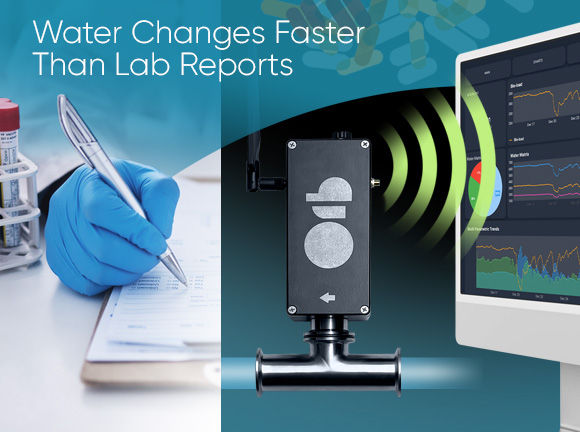
Yet most critical infrastructure still manages this risk using methods that belong to a different era. Laboratory analysis that takes two to three days remains the dominant way to assess biological conditions. If it takes three days to see what is happening, then for three days the system is effectively blind.
Operating blind does not mean operating safely. It means operating inefficiently.
The Cost of a Three-Day Blind Spot
Microbes do not operate on laboratory timelines. They respond immediately to changes in flow, temperature, pressure, and stagnation. While operators wait for results, biological conditions inside the system continue to evolve.
A three-day delay forces operators to compensate with assumptions. Cleaning is performed without knowing whether it is needed. Chemicals are dosed without knowing whether levels are too high or too low. Disinfection is applied conservatively to avoid risk, but often at the expense of efficiency and asset lifetime.
Blind operation leads to blind cleaning. That means excessive chemical use, unnecessary energy consumption, and avoidable wear on membranes, pipes, and metal infrastructure. Over time, this accelerates corrosion, degrades materials, and shortens system life.
The result is lost production time, higher operating costs, and increased failure risk. In many industrial systems, even a few hours of downtime per day can translate into significant economic loss.
A Global Problem, Not a Water Only Problem
Water networks are often where microbial risk becomes visible first, but they are not unique. Any system that stores, transports, or recirculates water faces the same biological dynamics.
Semiconductor fabs depend on ultra-stable water loops. Hospitals rely on water systems that must remain biologically safe at all times. Food and beverage plants operate continuous cleaning and production cycles. Pharmaceutical facilities manage closed water systems with strict quality requirements. Cooling systems and industrial utilities recirculate water under varying thermal and hydraulic conditions.
Across all of these sectors, microbes influence safety, efficiency, and performance long before traditional monitoring detects a problem.
Water underpins approximately sixty percent of global economic activity. A three day blind spot in biological visibility is not a local inefficiency. It is a systemic one.
Why Legacy Monitoring Cannot Scale
The core issue is not a lack of data. It is a lack of operational intelligence.
Laboratory methods provide accuracy, but they are slow and disconnected from real-world operation. Reagent based online tools offer more frequent measurements, but they depend on consumables, require maintenance, and typically operate on intervals that are not aligned with how biological systems behave.
Neither approach is designed for continuous, system wide intelligence. Neither provides the resolution needed to understand how microbial activity responds to real operating conditions at scale.
Modern infrastructure demands something fundamentally different.
Orb Is an Intelligence Company
Orb does not add another sensor to the system. It adds a new infrastructure layer.
Orb provides a Microbial Intelligence Layer that makes biological activity visible in real time. This layer allows operators to see how microbial risk evolves continuously, rather than reconstructing events after the fact.
With real-time microbial risk signals, operators can understand what is happening inside their systems as conditions change. They can validate treatment performance continuously. They can correlate biological behavior with flow, temperature, pressure, and operational events.
This capability did not exist before. It is not an incremental improvement on legacy tools. It is a shift from delayed measurement to live system intelligence.
From Reaction to Control
When microbial activity becomes visible in real time, infrastructure management changes.
Operators no longer need to compensate for uncertainty with conservative dosing or excessive cleaning. They can align actions with actual system conditions. Cleaning becomes targeted instead of routine. Chemical use becomes controlled instead of assumed. Asset protection becomes proactive rather than reactive.
This improves efficiency, reduces unnecessary stress on infrastructure, and supports longer system life.
Conclusion: Intelligence Is the New Infrastructure
Critical infrastructure depends on stability. Stability depends on understanding what is happening inside the system as it happens.
Microbes are not a secondary variable. They are a primary driver of risk, performance, and cost across industries that rely on water.
Orb delivers the missing intelligence layer that allows operators to see and understand microbial dynamics in real time. Better visibility leads to better decisions. Better decisions lead to safer, more efficient, and more resilient systems.
This is not only about drinking water. It is about every critical infrastructure system that depends on water to function.